In the first two posts in this series, we explored the evidence challenges around Engagement & Impact and Contribution to Knowledge & Understanding. Here, we turn to the third element of REF 2029 assessment: Strategy, People & Research Environment (SPRE) and what it takes to approach it with both credibility and confidence.
SPRE is often treated as the administrative pillar of REF, the section concerned with governance structures, research culture, and support systems. REF 2029 reflects a broader shift in research evaluation, placing emphasis on the conditions that enable excellent research, engagement and impact. Shaped by extensive sector consultation and piloting, the assessment now places greater value on institutional context, strategic intent, and evidence of effectiveness, recognising that positive research culture takes different forms across institutions and disciplines.
In practice, SPRE is considerably more demanding than the traditional framing suggests. Panels assessing SPRE look for institutions to articulate a coherent and credible account of how their research environment has developed, how it supports researchers at all career stages, and how institutional strategy is shaping the conditions for future research excellence.
That requires not just a well-written narrative, but one that can be traced back to evidence: investment patterns, collaboration networks, career development activity, researcher demographics, and infrastructure choices. Without that evidence base, even a well-constructed SPRE narrative risks appearing aspirational rather than grounded.
“The SPRE element is where institutions have to show that their environment is genuinely enabling their research, not just describe it. Panels can distinguish between a narrative that reflects a well-evidenced reality and one that is largely rhetorical,” explains Ann Campbell, Director Research Impact & Comparative Analytics at Digital Science.
Evidencing strategy and environment credibly
SPRE narratives are expected to show how strategy has shaped research activity over the assessment period and how it will continue to do so. That means institutions must position their strategic claims within a broader context: how their research portfolio benchmarks against institutions of similar profile, where they have invested relative to emerging fields, and where their environment has demonstrably strengthened research quality.
Dimensions data supports this kind of strategic evidence building by enabling institutions to monitor research activity, collaboration patterns and emerging strengths over time. Rather than focusing solely on comparison with peers, these data can help institutions assess progress intrinsically, providing evidence of how strategic priorities, investments and interventions have influenced research behaviours and contributed to the development of the research environment. For example, an institution seeking to create a more collaborative and externally connected research environment might examine changes in international and academic–industry collaboration over time. Dimensions enables institutions to track indicators such as the proportion of publications involving external partners, industry co-authors, or interdisciplinary teams, helping to build evidence of how strategic priorities have influenced collaboration behaviours and the wider research environment.
While no single metric can demonstrate the effectiveness of a strategy in isolation, trends in collaboration activity can provide valuable supporting evidence when considered alongside institutional priorities and reported activity.
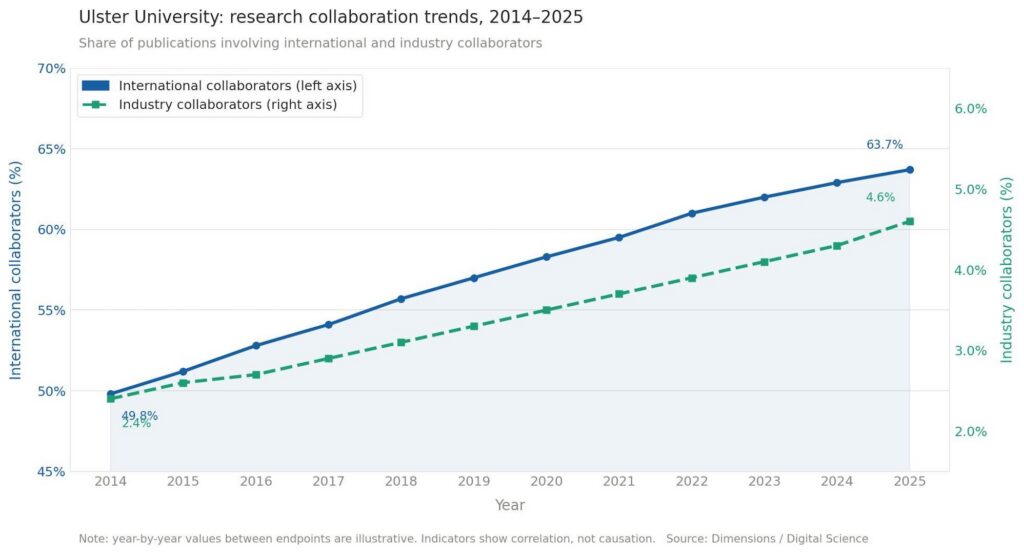
A practical example can be seen at Ulster University. The proportion of publications involving international collaborators increased from 49.8% in 2014 to 63.7% in 2025, while the share involving industry collaborators rose from 2.4% to 4.6% over the same period. Looking more closely at Information and Computing Sciences and Engineering – two areas aligned with strategic investments in Digital Healthcare, Artificial Intelligence, Advanced Manufacturing and the Belfast Region City Deal – publication output and engagement with both international and industry partners increased substantially over time. While these indicators do not demonstrate causation, they are consistent with a research environment that has become increasingly connected and externally engaged.
This is not about selecting evidence to fit a narrative. It is about building a sufficiently complete picture that the narrative reflects what the evidence actually shows – and that the gaps, where they exist, are understood and addressed before submission.
Mapping collaboration and demonstrating connection
Collaboration indicators can help evidence the effectiveness of institutional strategy, but collaboration is also a significant area of assessment in its own right within SPRE. Institutions must demonstrate not only that collaborations exist, but that they have created conditions enabling meaningful engagement across disciplines, sectors and international boundaries.
REF panels look for evidence of meaningful engagement with the wider research community, nationally, internationally, and across disciplinary boundaries. The challenge is that collaboration evidence is frequently scattered. Co-authorship data may be held in multiple systems. International partnerships may be documented in grant records but not linked to publications. Interdisciplinary work may not be captured consistently within any single Unit of Assessment.
“The institutions that can tell the clearest story about their collaboration environment are the ones that have been able to assemble a connected picture – not just outputs and grants in isolation, but how those things link to partners, to networks, to the world beyond the institution. That connected view is rarely available without deliberate investment in data infrastructure,” says Campbell.
Dimensions enables institutions to map collaboration networks at unit, discipline, or institutional level, surfacing international partnerships, cross-sector engagement, and interdisciplinary links in a way that supports both narrative construction and internal verification. Symplectic Elements complements this by structuring the local evidence layer: linking researchers to their outputs, grants and activity records in a way that is auditable, consistent, and provides the data governance that REF submissions require.
Career development, researcher wellbeing and institutional assurance
A significant strand of SPRE assessment focuses on how institutions support researchers across the career lifecycle: early-career researchers, those on fixed-term contracts, researchers returning from career breaks, and those working in interdisciplinary or applied fields that may not map neatly onto traditional academic career structures.
Panels expect evidence that institutions have thought carefully about equity and inclusion in their research environment, not as a compliance exercise, but as something visible in both data and narrative. That means demonstrating that early-career researchers are represented in outputs, that career development provision reaches those who need it, and that the research environment does not systematically disadvantage particular groups.
Institutional self-awareness matters as much as institutional performance. The ability to identify where evidence falls short, where coverage is uneven, or where certain groups are underrepresented is itself a sign of a credible, well-governed research environment.
SPRE submissions span multiple Units of Assessment, and each must cohere with the institution-level narrative. The risk of inconsistency, between institutional claims and unit-level evidence, or between different units’ accounts of shared infrastructure, is a practical one that affects many institutions.
As Campbell notes, “One of the things that makes SPRE preparation genuinely hard is that it requires consistency across the whole submission, not just excellence in individual parts. An institutional narrative that isn’t grounded in unit-level evidence, or vice versa, creates credibility gaps that panels notice.”
Good institutional assurance also requires a clear view of metadata quality and completeness. Where records are incomplete, inconsistently attributed, or missing key linkages, between researchers and outputs, grants and the work they funded, international partners and the collaborations they enabled, submission quality risks become difficult to manage without coordinated data governance.
Symplectic Elements supports institutional assurance by providing structured, auditable records of researcher activity, linking people, outputs and grants in a way that enables governance teams to identify gaps and inconsistencies before submission. Combined with the external validation layer that Dimensions provides, this gives institutions a more complete and more defensible evidence base for the decisions they need to make.
Open research as part of the environment narrative
REF 2029 places increased emphasis on open research practices as a feature of a healthy research environment. Institutions that can demonstrate strong open access compliance, a culture of data sharing, and investment in open research infrastructure are better placed to present a credible SPRE narrative.
Open research infrastructure, including institutional repositories such as Figshare, plays a practical role here. Persistent identifiers, FAIR-compliant data repositories, and transparent access to research outputs and datasets are not simply technical features. They are evidence of the kind of open, well-governed research environment that panels expect institutions to be building and sustaining.
Scholarly visibility tools such as Altmetric can provide supplementary evidence of how research outputs are engaging public, policy and professional communities – a useful addition to SPRE narratives that address engagement beyond the institution.
Institutions that prepare most effectively:
- benchmark research performance and strategic positioning using interconnected data solutions such as Dimensions, tracking trends over time and in disciplinary context
- map collaboration networks, nationally, internationally and across disciplines, to evidence the reach and depth of their research environment
- structure researcher activity records and governance through systems such as Symplectic Elements, linking people, outputs and grants with auditable consistency
- demonstrate open research practices through compliant, FAIR-ready infrastructure such as Figshare, making the breadth of research outputs visible and accessible
- use supplementary visibility data from tools such as Altmetric to situate research engagement within public, policy and professional discourse
REF readiness is about leading, not lagging. For SPRE, that means investing in the data infrastructure and governance practices that make the environment narrative credible, not constructing it retrospectively from incomplete records.
Digital Science supports this readiness through interconnected solutions that strengthen the evidence base for decision-making, while leaving judgement firmly with institutions and REF panels.
Digital Science can help your institution build a credible, evidence-grounded SPRE narrative for REF 2029.
The post REF readiness: evidencing Strategy, People & Research Environment appeared first on Digital Science.
from Digital Science https://ift.tt/h962Lrk


No comments:
Post a Comment