Digital Science’s UK Publisher Day 2026 brought together publishers, industry and technology partners to explore the evolving role of publishers at a time when the way we conduct and interact with research is changing.
Across keynotes, panels, lightning talks and case studies, participants at every stage of their careers – from early career professionals to established leaders in scholarly publishing – shared their perspectives on the challenges ahead.
Several themes emerged throughout the day:
- AI is reshaping how research is discovered and consumed
- Research integrity challenges are becoming increasingly complex
- Traditional publishing metrics are under pressure
- Collaboration across the research ecosystem is more important than ever
Together, these conversations painted a picture of an industry actively adapting to new technologies, new expectations and new responsibilities.
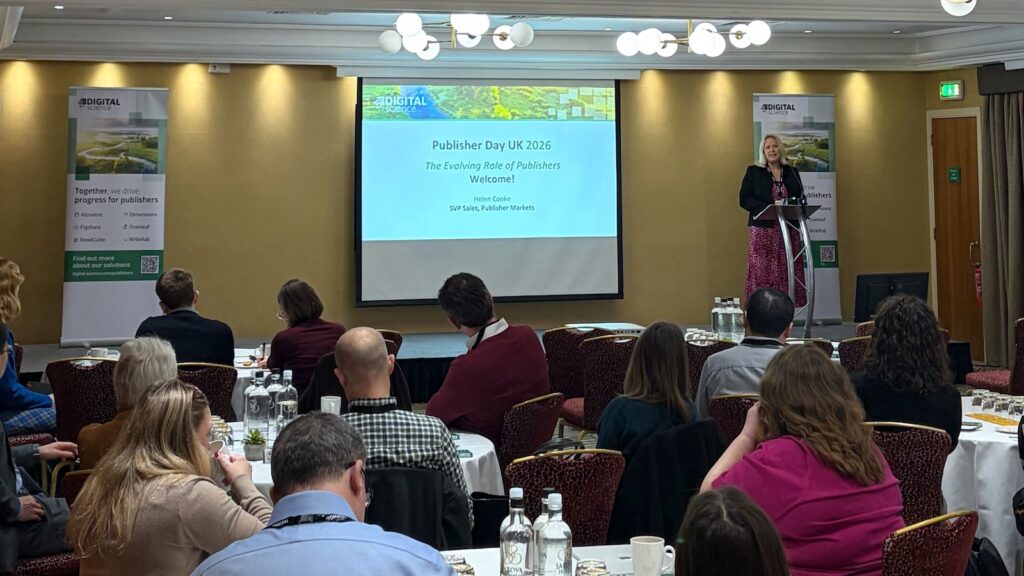
The state of scholarly publishing today
The opening keynote by Tim Gillett and Jon Hunt of Research Information explored the current dynamics between academia and the publishing industry, drawing on recent survey data comparing perspectives from institutions and publishers.
While the data showed areas of alignment around priorities such as research dissemination and impact, it also highlighted a persistent trust gap between institutions and the publishing industry. Institutions reported that industry support has improved since 2023, but progress has been gradual and expectations remain high.
Financial pressures across the research ecosystem are also shaping these relationships. Universities, funders and publishers are all navigating constrained budgets while trying to support increasingly complex research outputs and workflows.
A key question emerging from the discussion was who ultimately has the power to drive meaningful change within scholarly publishing. While no single stakeholder controls the system, the session suggested that progress will depend on clearer roles, stronger incentives for collaboration and continued dialogue across the community.
“The industry needs more conversation, clearer definitions of roles and responsibilities, and stronger incentives for collaboration.”
AI, however, was repeatedly highlighted as the issue that may reshape the industry most significantly in the coming years.
What early career professionals see as the future of publishing
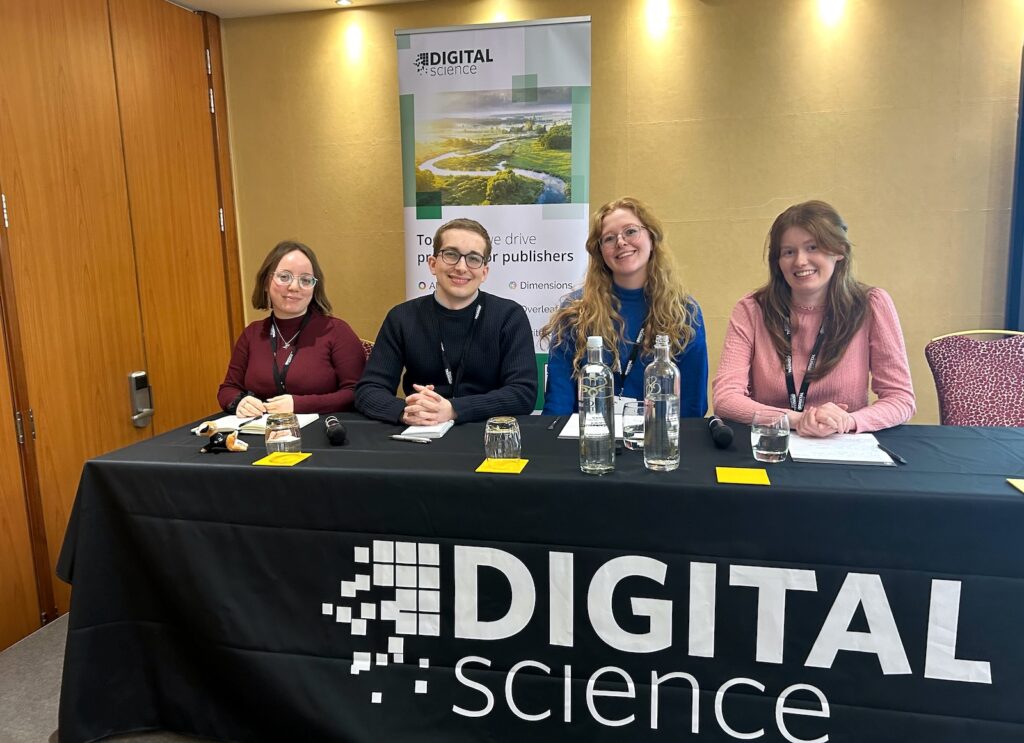
One of the highlights of the day was a panel bringing together early career professionals from across the publishing industry, including representatives from Emerald Publishing, Taylor & Francis, Bloomsbury and Portland Press.
The discussion offered valuable insight into how the next generation of publishing professionals view the future of the industry.
Participants highlighted both opportunities and challenges. Open access continues to reshape publishing models, but many authors still struggle to understand how it works.
“Open access is really exciting… but it can get very confusing.”
Peer review was also identified as one of the biggest operational challenges facing publishers today, with many journals finding it increasingly difficult to recruit reviewers.
The panel also reflected on the skills that will matter most in the coming decade.
Adaptability, curiosity and strong interpersonal skills were repeatedly mentioned, particularly as AI becomes more integrated into publishing workflows.
“Don’t be scared… be confident to give things a go.”
AI is reshaping how research is discovered
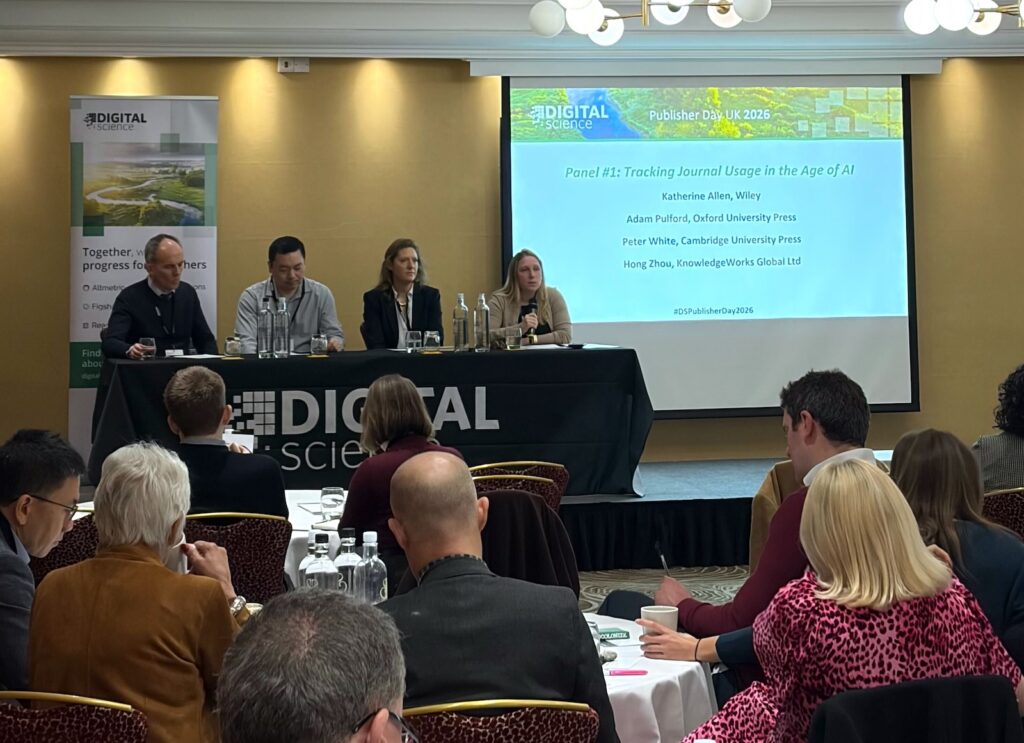
One of the most widely discussed topics of the day was the impact of Artificial Intelligence on research discovery. A panel discussion (conducted under Chatham House Rules) on journal usage in the age of AI explored how discovery behaviors are evolving as researchers increasingly interact with AI-driven tools.
Traditionally, researchers located content through keyword-based search and navigated directly to journal platforms. Increasingly, however, discovery is shifting toward natural language queries and AI-generated answers.
In this model, a researcher may ask a system a question, receive a summarized response, and never visit the original journal platform at all.
Publishers are already seeing early indicators of this shift. Click-through rates from search engines appear to be declining in some cases, while impressions of research content within search environments are increasing, creating a notable ‘crocodile effect’ within analytical performance.
The challenge for publishers is that research content may still be widely used, but the pathways through which it is accessed are becoming harder to observe directly.
In response, publishers are starting to rethink how content is structured and surfaced. It’s no longer just about optimizing for the end reader, but also for AI systems acting as intermediaries.
This introduces the idea of an “AI persona” alongside the traditional user persona. Content needs to be:
- Easy for machines to interpret and extract
- Supported by rich, structured metadata
- Written and formatted in a way that can be accurately summarized
As discovery continues to shift, the focus moves from driving clicks to ensuring content can be found, understood and used, whether by a human reader or an AI system.
Why research metrics are becoming harder to interpret
While discovery evolves, so too does the challenge of measuring research engagement.
Traditional metrics such as page views, downloads and click-through rates were developed for a web browsing environment. AI-assisted discovery introduces a different interaction model, where insights from multiple papers can be synthesized without the user visiting individual journal pages.
This means that impressions may increase while click-through rates decline, not because content is less useful, but because the user no longer needs to open each source individually and manually scan for the content they need.
For publishers, this creates a new challenge: understanding true research consumption in an ecosystem where AI systems increasingly sit between users and content.
Improving infrastructure will be essential to addressing this issue. Reliable identifiers, well-maintained repositories and rich metadata will all play a role in helping publishers understand how research flows across the ecosystem.
A publisher perspective on implementing integrity tools
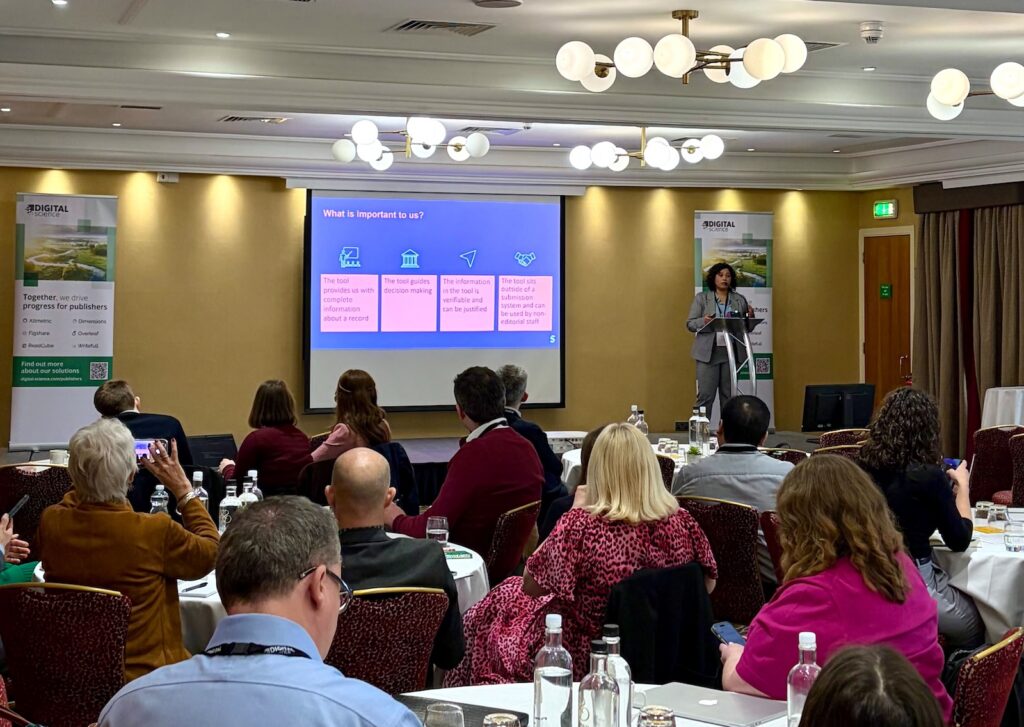
A case study from Dr Adya Misra of Sage, offered insight into how integrity tools are being deployed in practice.
The organization was the first publisher to deploy Dimensions Author Check internally and has since expanded its use beyond the research integrity team to commissioning and research engagement staff.
One of the key benefits has been the ability to consolidate information about authors and collaboration networks in a single environment, reducing the time required to validate researchers and investigate potential concerns.
“The tool provides us with the complete information about a record… we’re not having to look at multiple different information sources.”
At the same time, editorial judgement remains central to the process.
“We wanted the tool to guide our decision making but not insert it.”
The experience illustrates how integrity tools can support editorial teams while preserving the human judgement that remains essential to publishing decisions.
Detecting misconduct: the role of forensic scientometrics
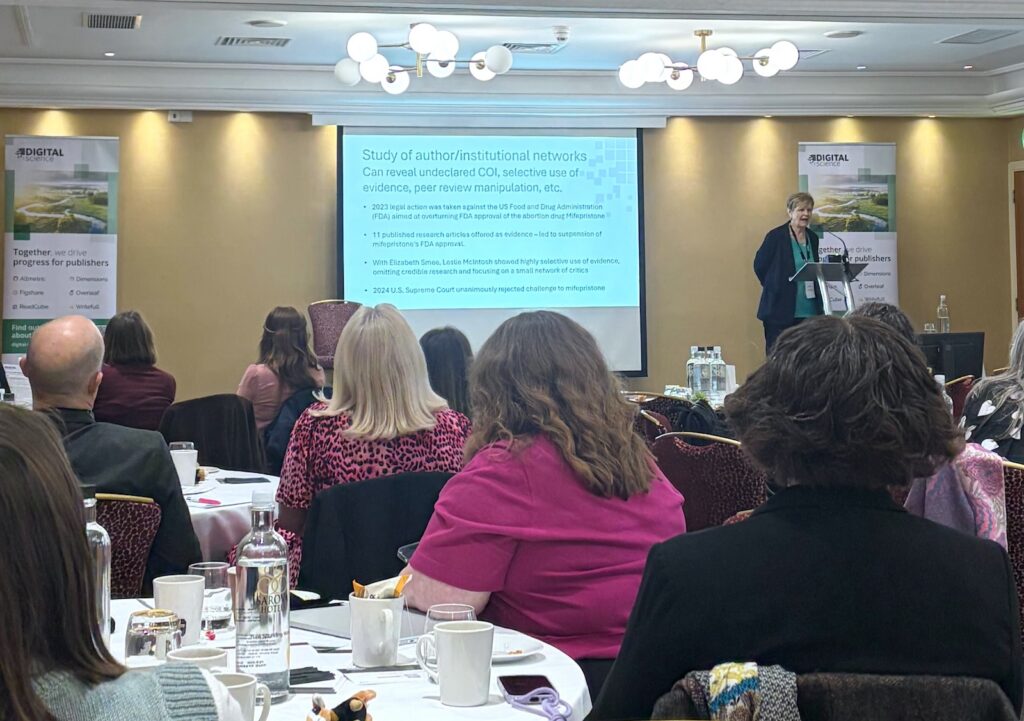
The final keynote from Emeritus Professor Dorothy Bishop offered a fascinating finale to the day, exploring the growing field of Forensic Scientometrics, associated with independent research integrity investigators sometimes referred to as “sleuths”.
Researchers in this area analyze patterns across the scholarly record to identify potential misconduct, including fabricated research, manipulated images and coordinated paper mill activity.
The work often involves detailed analysis of publication patterns and datasets. In some cases, investigators identify unusual terminology or data inconsistencies that suggest attempts to bypass automated detection systems.
Open data plays a crucial role in enabling this work, allowing researchers to verify findings and identify discrepancies.
However, many of the people carrying out these investigations operate independently, often without institutional support. The time required for formal investigations can also be significant.
Raising concerns about published research can carry reputational risk, particularly when it involves established authors or institutions. In some regions, there may also be broader concerns around professional security and personal well-being.
At the same time, formal investigations can take time. Verifying evidence and navigating editorial or legal processes often slows the path from suspicion to action.
This creates a gap where problematic research can continue to circulate, highlighting the need for better support for investigators and faster, more coordinated responses across the industry.
As Dorothy noted:
“On average it takes about… 250 days to retract an article.”
During that time, problematic research may continue to circulate within the literature.
The discussion raised important questions about how the industry can accelerate investigations while also supporting those working to identify potential misconduct.
Final reflections
Digital Science’s UK Publisher Day 2026 highlighted an industry in transition.
Artificial Intelligence is changing how research is discovered and consumed. Traditional engagement metrics are becoming less reliable indicators of research use. Research integrity investigations are growing in complexity. And across all of these issues, collaboration between institutions, publishers and technology providers is becoming increasingly important.
Just as importantly, the event demonstrated the value of bringing the scholarly communications community together.
Events like Publisher Day provide an opportunity to share perspectives, discuss challenges and build the relationships needed to navigate change across the research ecosystem.
The post Exploring the evolving role of publishers appeared first on Digital Science.
from Digital Science https://ift.tt/fYpboSD


No comments:
Post a Comment