The variety of channels and audiences that define scientific communications reach and engagement is growing. In turn, Medical Affairs teams face diversifying data sources and tools to assess publication performance.
Compass Points: The Future of Medical Affairs is a series exploring the strategic challenges facing medical affairs teams in today’s communication landscape—and the tools that will help them get it right.
Even the most groundbreaking data cannot change clinical practice if never translated into action. As such, a fundamental purpose of scientific communications is to inform and educate on this new data, what it means, and how it can impact the real world. The challenge is how to do this effectively across multiple regions, channels, and audiences, and how to track success (or failure).
As the complexity of scientific communication scales, Medical Affairs teams rely on an expanding library of data sources and tools to analyze the performance of scientific communications tactics. Quantifying asset performance and impact directly informs strategy, and in turn, informs publication planning. We see that this feedback loop propagates the outcomes of tactical and strategic decision-making, whether these outcomes were desirable or undesirable.
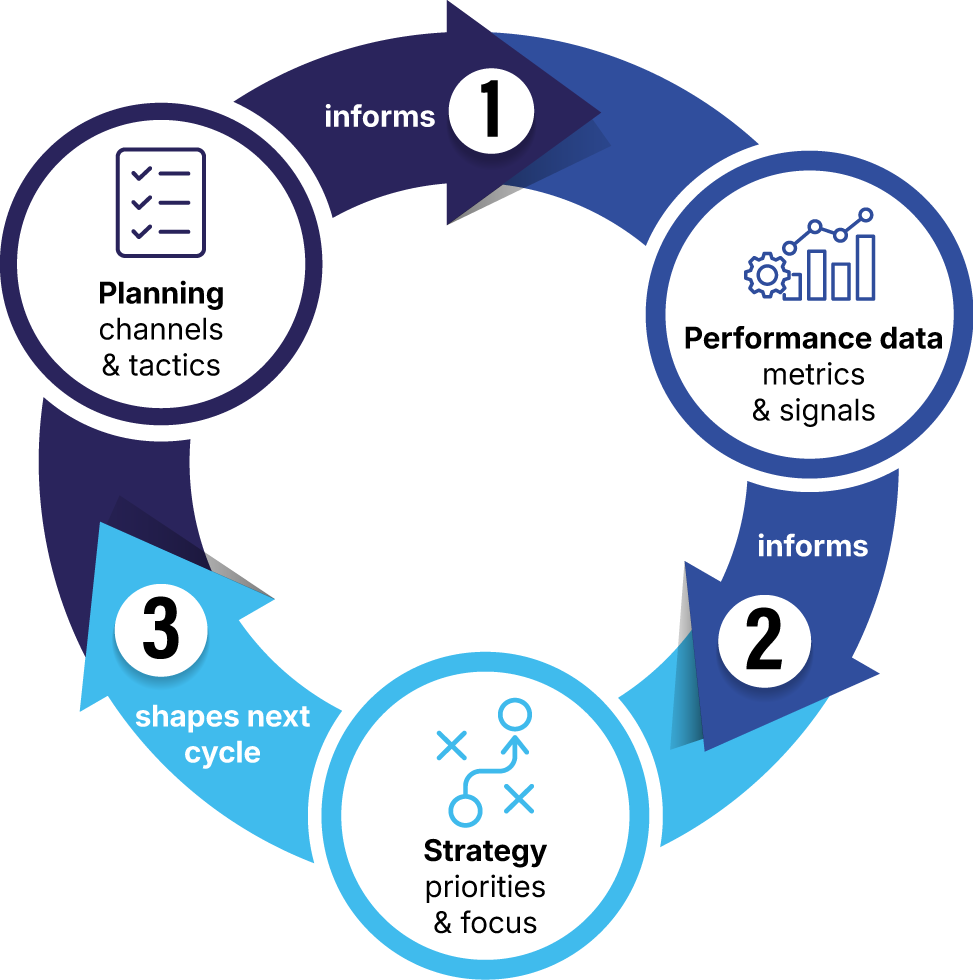
The growing availability of data sources and tools used to define publication performance is a double-edged sword: capabilities increase, but so, too, does workload. Assessments performed in different settings, at different time points, with non-standardized queries may create inconsistency in those outputs contributing to strategic decisions about publications. The value of scientific communications can be efficiently captured by measurement tools, such as Compass by Dimensions, characterized by integrated sources, standardized data, and intuitive performance benchmarking.
Limitations become visible when publication performance data sources and reporting tools are siloed.
As part of Medical Affairs scientific communications planning and evaluation, asset performance directly informs publications strategy. A growing variety of data sources and analysis tools are now available. These help determine publications’ reach and engagement, and by extension, their impact.
Citation tracking tools hold continued relevance. In what may represent a highly manual process, pertinent altmetrics must first be defined, then followed over time. Social media listening offers publication performance insights from an altogether different channel. To assess proprietary (or competitor) abstracts, posters, and podium presentations, congress trackers of varying complexity are commercially available or developed in-house. Whether for conferences, publishers, or individual journals, both the type and availability of performance metrics vary widely.
These examples are not comprehensive. As their variety suggests, publication performance data sources and reporting tools are often functionally siloed from one another. They must be evaluated in turn, and the readouts integrated, to generate a comprehensive snapshot.
Being inherently decoupled, it follows that the data sources and reporting tools illustrated here will lack technical platform interoperability. Plainly stated, they don’t communicate. As such, they are limited in their ability to provide integrated readouts and a contextual story of scientific communications asset performance.
What does this mean for user experience and workload?
Across life sciences industries, the size, structure, and distribution of Medical Affairs and publications teams differ significantly. Scientific communications strategy may be defined within the Medical Affairs functional area alone, or within a cross-functional center of excellence or integrated evidence planning team.
Where data and reporting tools are managed by a group of colleagues, only by investing time and aligning their efforts can these contributors integrate findings into a cohesive performance narrative. If such coordinating and reporting activities are repeated on a monthly basis, for example, we begin to grasp the many people-hours required. In the present era of remote work, it’s likely that these team members do not work in the same physical space, or even the same time zone. Creating the impact story requires continuous touchpoints, further decreasing efficiency.
It is important to highlight this concept of the scientific communications impact story, as creating it is just one step in the process. Another key aspect is telling that impact story effectively to leadership and other key stakeholders. How are the publication performance data contextualized? What reporting content can decision-makers expect to see, and reliably?
A holistic scientific communications performance overview, delivered on-schedule with consistent format, takes significant time and effort, whether the overview’s creator is a team or a single contributor.
In the case of a single contributor such as the publications manager or director, this colleague is solely responsible for the time-consuming, repetitive work of integrating increasingly complex data sources and tools. Expertise more impactfully invested in key project management and strategic activities is instead diverted to data analysis. The workload risks overwhelming that colleague.
Whether in (bio)pharma, biotech, or medtech organizations, this situation’s impact may be more acutely felt in publications teams serving multiple disease or product areas. In a further example, its impact is visible in small- and medium-sized life sciences companies, where publications colleagues may “wear other hats,” having broader role descriptions or functional responsibilities.
When publication performance insights are integrated from diverse sources, how does this influence their perception?
Building on this, publications teams are facing operational environments in which scientific communications performance assessment and reporting processes become overwhelming.
While these may be subject to formalized standard operating procedures, it’s more likely that practices fluctuate over time: team structures change, or publication types evolve. Inherent knowledge informs the work of integrating performance data from diverse sources, often depending on personal best practices. Processes become opaque, and as the risks of missing relevant data and of differing interpretations increase, reporting inconsistencies emerge.
Whether monitoring owned or competitor assets, publication performance reporting serves myriad purposes. These range from publication impact measurement, to downstream budget and strategy planning, to competitive intelligence. Performance reporting is meant to describe impact and value.
Should the integrated insights appear inconsistent, this perception affects stakeholders. It reflects negatively on the work and reputation of the publications or scientific communications team, the Medical Affairs team, or the integrated evidence planning team. Cross-functional partners or leadership may perceive the accumulated insights as unreliable, or even non-actionable. Over time, this hinders effective business decision-making, perceived department value, trust, and even individual working relationships.
Data integration workarounds that utilize generative artificial intelligence lack fidelity.
In the last three years, multimodal generative artificial intelligence (genAI) technologies have gained significant traction as data integrators. Their ability to instantaneously compare inputs, summarize findings, and create personalized outputs feels reassuring. With remarkable efficiency improvements, a single user can develop polished, on-brand content and dashboards in minutes.
GenAI technologies may represent a tempting solution to the challenge of publication performance data collected from such disparate sources and tools. This is especially true for life sciences organizations holding enterprise agreements that facilitate company-managed access to these technologies.
It is critical to balance the benefits of improved efficiency against the limitations of utilizing genAI as a process workaround to analyze and integrate publication performance data. Due to these technologies’ very design, they are neither able to consistently benchmark nor to track target performance metrics over time. As such, assessments remain snapshots that must be repeated according to stakeholders’ reporting requirements.
Hallucination and sycophantic responses are known challenges with the use of genAI. Outputs with publication performance data integration as their goal may be incomplete, factually incorrect, or biased. A genAI-grounded process still relies on the user to identify and supply trusted data sources. If pertinent metrics are missing, genAI-directed data integration processes cannot account for them. Alternatively, depending on how the user prompts the model, they may have the undesirable experience of hallucinated metrics or outputs.
The use of genAI to speed up integration of disparate, disconnected data sources should not come at the cost of insight fidelity. Rather, when artificial intelligence capabilities are paired with data analytics, reliable analyses require standardized, consistent data feeds from curated sources. When a publications team builds such analytics de novo, both the data sources and analytics outputs take time to verify and to trust.
Standardization and repeatability are key to successful publication performance assessment.
Capturing the value of scientific communications should not be held back by the repetitive work of reconciling disparate data sources. Nor should strategy-defining insights depend on workarounds, themselves subject to technical limitations. As well, it is worthwhile to consider the accumulated inefficiencies that these activities create for publications managers and teams.
Measurement tools that integrate data sources by their design unlock the power of user-defined search and tracking parameters. Meaningful insights are uncovered when these parameters are standardized and repeatable, tracking publication performance with consistency over time. When unique, Medical Affairs-relevant data sources come already embedded, it streamlines the work of uncovering scientific communications reach, engagement, and impact. This diversity of data is no longer an obstacle.
Compass by Dimensions captures these capabilities. Built on more than a decade of Dimensions and Altmetric data trusted by industry, it is designed to help overcome the challenge of data diversity. Compass combines publication and altmetrics into a single collaborative workflow, reducing inefficiencies, saving time, and simplifying how publications professionals and Medical Affairs teams benchmark, track, and manage publication impact and reach.
Compass by Dimensions is developed by Digital Science, an AI-focused technology company that transforms fragmented data into unified knowledge assets, leveraging AI and Knowledge Graphs to deliver structured, actionable intelligence for high-value discovery and innovation. By combining unparalleled data depth and breadth with enterprise-ready AI technology, we help leaders confidently accelerate product life cycles and secure a decisive market lead.
The post A double-edged sword: the growing complexity of Medical Affairs publication performance data appeared first on Digital Science.
from Digital Science https://ift.tt/tuWEXl6


No comments:
Post a Comment